

We Read a Merchant's Support Inbox for a Week. 44 of 61 Emails Were the Same Four Questions.
A merchant asked us to look at their support setup. A week of their inbox came back as 61 emails, and 44 of them were four questions asked over and over. Every answer already existed somewhere on their site. None of it was where the shopper was standing. Here is what we changed and the engineering bits that mattered.
FAQ
5 minute

A merchant selling home fragrance products asked us to look at their support setup. Not because it was broken. Because one person on their team was spending most of every morning in the inbox and they wanted to know whether that was normal.
We asked for a week of emails with the customer details stripped out. 61 messages came back. 44 of them were four questions:
How long does shipping take to my country?
Is this safe around pets?
What size room does one diffuser cover?
Can I return it if I don't like the scent?
Every one of those answers already existed on their site. Two were in the shipping policy page. One was buried three paragraphs into a product description. The pet safety answer was in a blog post from 2023.
The information wasn't missing. It just wasn't where the shopper was standing.
The email is the good outcome

This is the part merchants underestimate. A support ticket means the shopper cared enough to wait for you. You still get a chance to close the sale.
The expensive version is quieter. Somebody has a question at 11pm, doesn't see an answer, opens a second tab, and buys from a store that answered it. You never find out that happened. It doesn't show up in your inbox and it doesn't show up as a return. It shows up as a conversion rate you can't explain.
Returns work the same way. A shopper who guesses wrong about coverage area or scent strength sends the product back, and you pay for the shipping, the restock, and the refund on a sale you technically made.
What we built into FAQ Expert, and why each piece exists
FAQ Expert puts answers on the product page and the page templates where the question actually gets asked. That's the whole idea. Below are the decisions behind it that aren't obvious from a feature list.
Grouped FAQs, because a 30-item list is worse than none
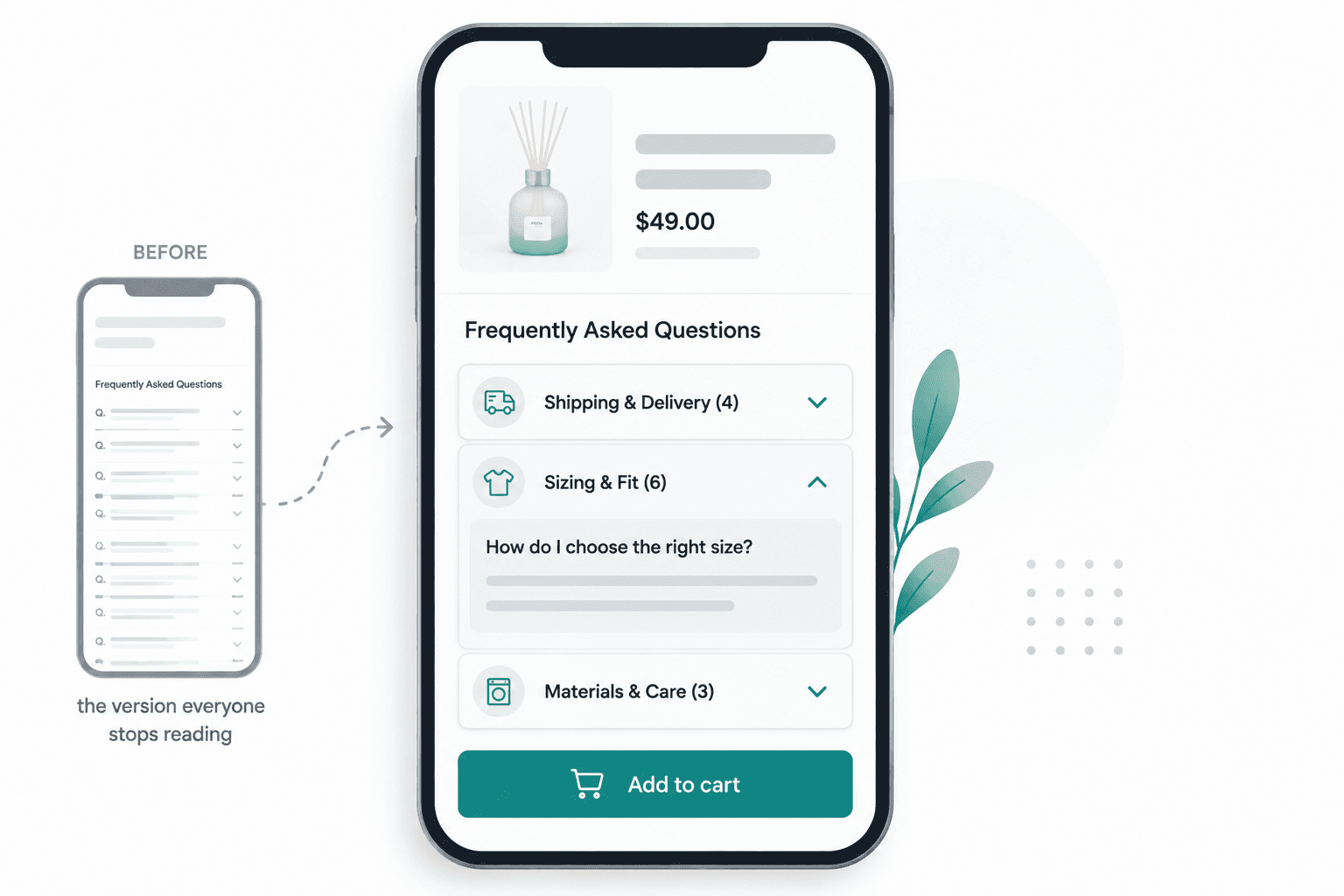
The first version of any FAQ section is fine. By month four it's thirty questions in one scrolling column and nobody reads past the fifth. On mobile that's a wall.
So FAQs attach to categories that collapse. Shipping and Delivery. Sizing and Fit. Materials and Care. A shopper opens the one that matches their doubt and skips the rest.
Schema that doesn't fight your theme
Here's the engineering detail I'd want to know as a merchant.
Plenty of Shopify themes already output FAQPage structured data, and some review or accordion apps do too. If your FAQ app blindly injects a second FAQPage block on the same URL, you now have two competing definitions of the same thing on one page. Google's rich results test flags it, and in the worst case the whole block gets ignored. You installed an SEO feature and quietly turned it off.
FAQ Expert checks what's already on the page before it renders schema, and it renders only the questions that are actually visible to the shopper. Marking up hidden or unpublished content is a fast way to get structured data ignored across your whole store, not just that page.
Ask a Question goes to a review queue, never straight to the page
Shoppers can submit their own questions from the product page. Those land in a queue for you to approve, edit, or answer privately.
Auto-publishing shopper-submitted text onto a storefront is a bad idea and I'd argue nobody should ship it. You'd be handing anyone with a browser a text box on your product page. The moderation step is the feature, not the friction.
Bulk import, because nobody is typing 400 FAQs
If you sell 200 SKUs and each needs a handful of answers, hand entry is not a plan. Upload a CSV and the catalog fills in one pass.
Language follows the storefront
FAQs switch with the shopper's storefront locale instead of making you maintain a duplicate set per market. If you sell into more than one country this is usually the difference between keeping the FAQs current and abandoning them by quarter two.
About AI search, honestly
You'll see a lot of writing right now about getting your store quoted by AI assistants, and structured FAQ data is usually the thing being sold.
Schema markup is worth doing. It makes your answers machine-readable, and answer engines pull from content they can parse. But it isn't a switch. If your answers are one vague line each, structured data just makes vague content easier to skip. The stores getting pulled into AI answers wrote specific answers first. "Ships in 3 to 5 business days within India, 10 to 14 days internationally" is quotable. "Shipping times vary" is not.
Write the answers properly. Then the markup does something.
What changed for that merchant
They loaded their four repeat questions plus about twenty more onto the relevant product pages and their shipping and returns pages. Took an afternoon.
Six weeks later we pulled the same week-long sample. 23 emails. The pet safety question had stopped appearing entirely, because it was now sitting under the Add to Cart button instead of in a two-year-old blog post.
The morning inbox routine went from most of a morning to about twenty minutes.
Pricing, plainly
There's a Free plan with 5 product FAQs, 5 page FAQs, 25 questions, full schema output, bulk import, and the Ask a Question widget. That's enough to test the idea on your five worst repeat questions before you pay anything.
Basic is $5.99 a month and Advance is $9.99 a month, which raise the FAQ and question limits and add design support. Large catalogs can ask us for a custom plan.
Start with the questions you're already answering
You don't need an FAQ strategy. Open your support inbox, read the last fifty messages, and count which questions repeat. Those are your FAQs. Everything else is guessing.
If your catalog is large or your setup is unusual, and you'd rather someone map it out with you, we can help with that too.
Ready to answer the questions before they get asked? Install FAQ Expert free from the Shopify App Store, or tell us about your setup.

Ashok Damaniya is the Chief Technical Officer (CTO) at Essenify, where he leads the development of Shopify apps focused on helping merchants increase sales and improve the customer experience. His expertise spans Shopify app architecture, e-commerce solutions, and scalable cloud infrastructure. He is passionate about building practical tools that solve real merchant problems and enjoys turning insights from the Shopify ecosystem into products that are simple, reliable, and impactful.
Reader guide
Use the links below to jump into next reading without leaving the article flow.
Blog categories
Recent posts
First Order Discounts: How to Increase Shopify Conversions
10 minutes
How to Feed Dynamic, Merchant-Configured Data Into a Shopify Function (Input Query Variables Explained)
10 minuts
How to Bulk Update Shopify Prices Without Losing Your Original Ones
5 minutes
What Shopify’s Native Discounts Can’t Do, and Why We Built Discountify
4 minutes

